The ornamental fish trade takes millions of fish from the sea every year. Only one in five survives long enough to make it to home aquariums. One solution would be to raise fish in captivity for this market. A piece from 2012 I was reminded of by a recent article in The Revelator (https://therevelator.org/ornamental-fish-trade/).
Showing posts with label oceans. Show all posts
Showing posts with label oceans. Show all posts
Saturday, December 7, 2024

Monday, January 30, 2023
Protecting whales from underwater noise
Underwater noise generated by human activity wreaks havoc with marine animals that rely on sound, including whales. Technology could help make things quieter in the sea. Read more here.
Wednesday, July 21, 2021
Kelp Loss on the West Coast
Divers and scientists watched a disaster play out along the U.S. West Coast: an almost overnight disappearance of sea stars, especially sunflower sea stars, followed by a population explosion of the purple urchins that sea stars eat, and then loss of entire forests of bull kelp. Read what is behind the disaster and what scientists are doing in response here.
Thursday, June 10, 2021
Protecting ocean sediments from trawling
Marine sediments represent a large and globally important carbon sink, but stored carbon can be released into the water by trawling. Research outlines the problem and offers solutions. Read more here.
Thursday, April 8, 2021
Fascinating Jellyfish
From their multiple-stage life cycles to their long history across the breadth and depth of the world’s seas, jellyfish may have something to tell us about the changing health of the oceans. Read more in this piece from the Spring 2018 issue of Alert Diver.
Wednesday, March 3, 2021
Mangroves in Peril
Earth has lost as much as 35 percent of its mangrove forests in the past few decades, and scientists predict that these vital ecosystems could all but disappear in the next 100 years. Read more about the problem here.
Sunday, October 25, 2020
The Gulf of Mexico
11 things you might not know about this body of water, also known as The American Sea. Some cool facts and some alarming ones. Read it here.
Tuesday, August 11, 2020
Saving Endangered Marine Species
Iconic ocean animals are disappearing as Earth faces a sixth major extinction event. Read about how people are working to protect them, and ways you can help in this piece from Scuba Diving.
Monday, July 29, 2019
More on Sargassum
Spring and summer 2018 saw yet another Sargassum bloom to the Caribbean, with piles of the stuff floating nearshore and
covering beaches in Little Cayman, Barbados, Antigua, and other
destinations. Read about why that happened and how divers can work around it.
Thursday, July 18, 2019
Coral reef ecosystems in trouble
Coral reefs cover less than 1 percent of the Earth’s surface yet feed and shelter a significant amount of marine life and provide food, coastal protection, and livelihoods for millions of people. Read about the state of the world's coral reefs in this PBS Nature Blog post. Spoiler alert: it isn't pretty.
When Light Becomes Pollution
Artificial light at night affects wildlife in many ways, including, according to some recent
studies, by increasing predation on insects, decreasing amphibian
reproduction, and interfering with nocturnal pollinators. Read more about the problem and easy solutions in this PBS Nature Blog post.
 Image: NASA Earth Observatory

Wednesday, September 19, 2018
Coral's big summer
On coral reefs around the world, certain species practice impressive mass spawning. Read about the spawning event at the Flower Garden Banks National Marine Sanctuary in this post for the PBS Nature Blog.
Tuesday, August 14, 2018
Too much of a good thing
Another post for the PBS Nature Blog's summer of love, this one about recent Sargassum blooms. While the floating algae provide habitat and food for a wide variety of marine life in the Caribbean and Atlantic Ocean, blooms are taking it a bit too far.
Friday, June 10, 2016
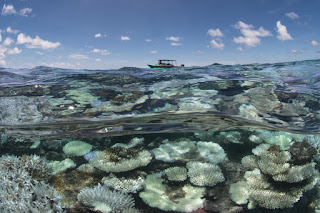
Coral bleaching is bad. Really bad.
The longest global coral bleaching event has already affected some 90 percent of the Great Barrier Reef and shows no signs of slowing down. Read the alarming facts in my piece for Mental Floss.
Photo credit: XL Catlin Seaview Survey.
![]() Cre
Cre
Photo credit: XL Catlin Seaview Survey.

Wednesday, September 30, 2015
World's best places to shore dive
Ten destinations where great diving is just a walk off the shore, making it
easy to pack in lots of diving along with taking it easy on the
beach and other fun. Read about them in my piece for Men's Journal.
 Diving at Storms River mouth, South Africa.

Thursday, August 27, 2015
Marine Protected Areas that Work
Not all marine protected areas work. Those that do have five characteristics. Read more in my article for Sport Diver.


Monday, August 17, 2015
Oceans of plastic
According to a study by a group at the National Center for Ecological Analysis and Synthesis, more than 10 billion pounds of plastic enter our oceans every year. We can do something about it. Read more in my story for the summer issue of Alert Diver.


Subscribe to:
Posts (Atom)